
Almost every individual across the globe works for a living, and the compensation they receive for their efforts is incredibly important. Every organisation should follow a fair payout to make sure there is no employee dissatisfaction. This is why employers prefer payroll software in Australia, which leaves no room for errors.
If employees don’t receive the compensation on time, it results in frustration and eventually, there will be a lack of trust. On the other hand, admin teams, HR, finance, and other departments may face difficulties while processing the complex payroll of employees. Payroll management will become a daunting task due to fluctuating hours, calculations of allowances, and adhering to tax requirements.
Payroll software makes it easier for businesses to manage their employees’ salary compensation every month. The streamlined and automated process powered by cloud storage is an excellent choice for businesses of all sizes, especially small and medium-sized businesses. With HR technology accessible to everyone, organisations have to consider picking up a reliable software for salary calculations.
Table of Contents
What is Payroll Software?
Payroll software is a cloud-based solution that helps businesses automate and handle salary processing. With an efficient payroll solution, it will be easier for the organisations. It will streamline the entire payroll process, making it more accurate, efficient, and compliant with ever-changing labour laws and tax regulations.
As companies in Australia should always ensure that they abide by the legislative requirements when paying their employees, payroll software becomes an important tool. Businesses failing to follow the tax regulations might deal with penalties or legal issues. It saves a lot of time for HR teams by automating redundant tasks like calculations, tax filings, and payment distribution.
This time-saving allows HR professionals to focus on more strategic initiatives like employee engagement, talent acquisition, and other HR activities that drive organizational growth. By integrating payroll software into the business, companies not only save time but also minimize the risk of errors and non-compliance that can arise from manual payroll processes.
Payroll Process in Australia
Employee Data Accumulation:
The first step in the payroll process is collecting employee information. Accurate data collection is crucial for ensuring that all payments and deductions are correct. It is important to gather basic details such as name, address, email, and Tax File Number (TFN). These pieces of information are essential to ensure compliance with tax regulations and are essential for issuing the correct payment.
Additionally, businesses may also need to gather other information, such as bank account details for payment processing, emergency contact details, tax residency status, and any allowances or deductions. Payroll software in Australia has a centralized database where this data can be securely stored and easily accessed when required.
The accuracy of the employee data collected at this stage plays a significant role in ensuring the payroll process runs smoothly and helps avoid issues like delayed payments or incorrect tax calculations.
Setting Hourly Wages or Salary Payout Details:
For every employee, businesses must define their pay structure. Employees either get an hourly basis or a fixed salary. The next step in the payroll process is setting the hourly wages or salary payout details for each employee based on their agreed-upon compensation.
Hourly workers are typically paid based on the number of hours worked, while salaried employees receive a fixed amount, regardless of the hours worked. Payroll software makes this process easier by allowing businesses to input pay rates for each employee and calculate the gross salary automatically. It also helps to track overtime hours for hourly employees, ensuring that they are compensated accordingly.
Validating Attendance Data:
Accurate attendance data is critical for calculating employee pay, especially for hourly employees. Payroll software in Australia can automatically validate attendance data by cross-referencing employee timesheets, including clock-in and clock-out times, as well as any breaks taken during the workday.
The software will also ensure that any discrepancies or errors in the timesheet data, such as missing punch-in/out times or incorrect hours logged, are flagged for correction. Additionally, businesses can check the time-off data, which includes paid time off (PTO) and unpaid leave, to ensure that leave balances are accurate. Validating attendance data is a critical step to ensure employees receive a fair pay for their work.
Implementing Pay Calculation:
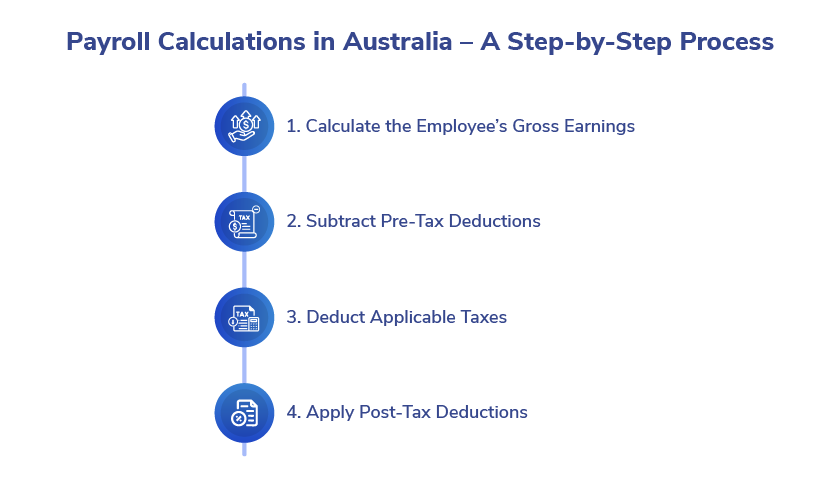
After data validation, the next step is to calculate the gross salary of employees based on their hourly wages, salary details, and any other time worked, such as overtime or extra shifts. Payroll software helps to automate these calculations, minimizing the chances of human error and ensuring employees receive accurate pay.
In addition to calculating the base pay, payroll software can also account for any bonuses, commissions, or other forms of compensation that may be due to the employee. This step is particularly important for businesses with varying employee pay structures, as it ensures that all employees receive correct pay according to their specific agreements.
Allowances and Deductions:
The next step in the payroll process is adding allowances and deductions. These include mandatory deductions like tax withholdings, superannuation, student loans, and any other benefits or entitlements. Payroll software can automatically calculate these deductions based on the employee’s income and tax code.
Furthermore, payroll software can also handle other types of deductions or allowances, such as those related to employee benefits, garnishments, and loan repayments. By automating the calculation and application of these allowances and deductions, payroll software ensures that employees’ pay is accurate and compliant with Australia’s tax laws.
Employee Payment:
In Australia, employees are typically paid weekly, fortnightly, or monthly. Payroll software facilitates this by scheduling payments automatically and ensuring that employees are paid on time. It can also generate payment records for employees to track their earnings and deductions.
Payroll software in Australia enables seamless payment distribution via various methods, including direct deposit to employees’ bank accounts, providing businesses with flexibility in how payments are made. This process is simplified and automated, reducing the risk of delays or errors in payment processing.
Records Management:
Once the payroll process is complete, it is essential to keep all payroll records for future reference. In Australia, businesses must retain payroll records for a specific period in compliance with tax and employment laws.
Payroll software offers secure storage for all payroll records, allowing businesses to maintain these records in an organized and easily accessible format. This is particularly useful in the event of an audit or when resolving employee disputes related to pay. By storing payroll data digitally, businesses ensure that records are safe, accurate, and compliant with the law.
Wrapping Up
Payroll software is crucial for Australian businesses, especially as payroll processes become more complex with each passing year. By investing in software, companies can implement a reliable payroll process across every phase of salary calculations. From data collection to payment and record management, DigiSME payroll software simplifies tasks, reduces errors, and frees up HR teams to focus on more strategic initiatives.
Ready to transform your payroll process? Schedule a demo to start your journey
